Loading...
Searching...
No Matches
Core Magic API
Core file type identification functionality. More...
Collaboration diagram for Core Magic API:
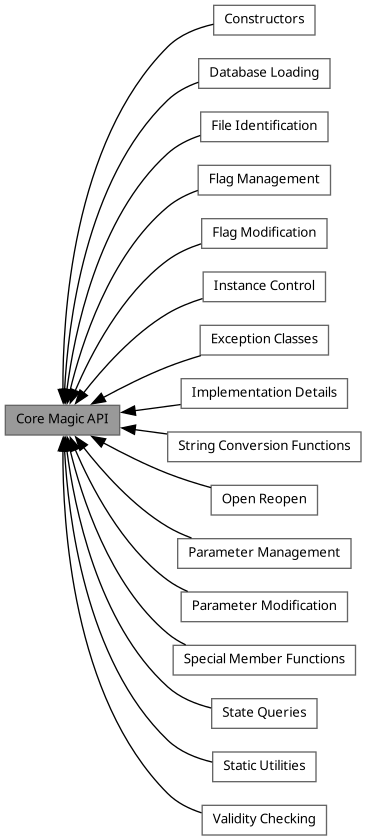
Topics | |
| Constructors | |
| Magic construction methods. | |
| Special Member Functions | |
| Move, copy, and destruction operations. | |
| Validity Checking | |
| Instance and database validation methods. | |
| Instance Control | |
| Instance lifecycle management. | |
| Flag Management | |
| Flag retrieval methods. | |
| Parameter Management | |
| Parameter retrieval methods. | |
| Static Utilities | |
| Static utility methods. | |
| File Identification | |
| Core file type detection methods. | |
| State Queries | |
| Instance state inspection methods. | |
| Database Loading | |
| Magic database loading methods. | |
| Open Reopen | |
| Instance initialization methods. | |
| Flag Modification | |
| Flag modification methods. | |
| Parameter Modification | |
| Parameter modification methods. | |
| String Conversion Functions | |
| Free functions for converting Magic types to human-readable strings. | |
| Exception Classes | |
| Exception hierarchy for Magic class error handling. | |
| Implementation Details | |
| Internal implementation details for the Magic class. | |
Classes | |
| class | Recognition::Magic |
| A modern C++23 wrapper for libmagic — the library that powers the Unix file command. More... | |
Detailed Description
Core file type identification functionality.
The Magic class provides the primary interface for identifying file types using magic number analysis. It wraps the underlying libmagic C library with a modern, type-safe C++23 API.
Quick Start
#include <magic.hpp>
#include <print>
using namespace Recognition;
int main() {
// Create and configure Magic instance
Magic magic{Magic::Flags::Mime};
// Identify a file
std::println("File type: {}", type);
return 0;
}
A modern C++23 wrapper for libmagic — the library that powers the Unix file command.
Definition magic.hpp:216
FileTypeT IdentifyFile(const std::filesystem::path &path) const
Identify the type of a single file.
Definition magic.cpp:2530
Main header file for the libmagicxx library.
Root namespace for the libmagicxx library.
Exception Safety
Most methods have two overloads:
- Throwing version: Throws exceptions on error (default)
- Noexcept version: Returns std::optional or std::expected (pass std::nothrow)
// Throwing version
try {
auto type = magic.IdentifyFile(path);
// Handle error
}
// Noexcept version
auto result = magic.IdentifyFile(path, std::nothrow);
if (result) {
// Use *result
} else {
// Handle error via result.error()
}
Base exception class for all Magic-related errors.
Definition magic_exception.hpp:102
Enumeration Type Documentation
◆ Flags
| enum Recognition::Magic::Flags : unsigned long long |
Flags for configuring Magic behavior.
The Flags enum controls how Magic identifies files and formats output. Flags can be combined using bitwise OR operations.
Common Flag Combinations
// Get MIME type only
Magic magic1{Magic::Flags::MimeType};
// Get full MIME with encoding
Magic magic2{Magic::Flags::Mime};
// Follow symlinks and decompress files
// Using a container of flags
Magic() noexcept
Default constructor. Creates an unopened Magic instance.
Definition magic.cpp:2421
- See also
- SetFlags() to change flags after construction
- GetFlags() to retrieve current flags
- Since
- 10.0.0
◆ Parameters
|
strong |
Parameters for tuning Magic behavior limits.
The Parameters enum provides access to various internal limits that control how deeply Magic analyzes files. Adjusting these can help balance between thoroughness and performance.
Magic magic{Magic::Flags::Mime};
// Limit bytes scanned for faster performance
magic.SetParameter(Magic::Parameters::BytesMax, 1024 * 1024);
// Get current value
// Get all parameters
auto params = magic.GetParameters();
for (const auto& [param, value] : params) {
std::println("{}: {}", ToString(param), value);
}
friend std::string ToString(Flags)
Friend declaration for ToString(Flags) free function.
Definition magic.cpp:2355
ParameterValueMapT GetParameters() const
Get all parameter values.
Definition magic.cpp:2513
std::size_t GetParameter(Parameters parameter) const
Get the value of a specific parameter.
Definition magic.cpp:2500
void SetParameter(Parameters parameter, std::size_t value)
Set a single parameter value.
Definition magic.cpp:2697
- See also
- SetParameter() to modify a single parameter
- SetParameters() to modify multiple parameters
- GetParameter() to retrieve a single parameter value
- GetParameters() to retrieve all parameter values
- Since
- 10.0.0