Comprehensive examples demonstrating libmagicxx usage. More...
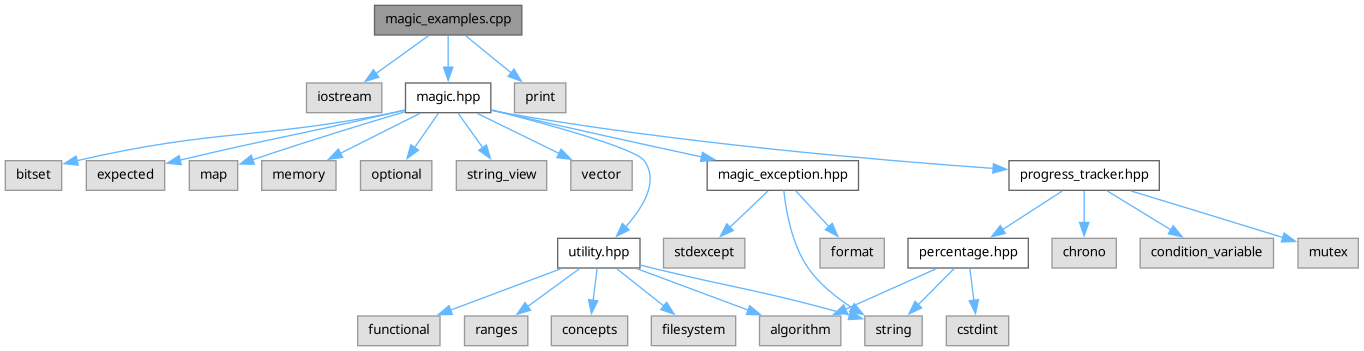
Functions | |
| void | ExampleBasicIdentify () |
| Example 1: Basic file identification with exception handling. | |
| void | ExampleNoexceptIdentify () |
| Example 2: File identification using the noexcept API. | |
| void | ExampleIdentifyDirectory () |
| Example 3: Batch identification of files in a directory. | |
| void | ExampleCustomFlagsParameters () |
| Example 4: Configuring flags and parameters. | |
| void | ExampleCheckAndCompile () |
| Example 5: Database validation and compilation. | |
| void | ExampleProgressTracking () |
| Example 6: Progress tracking for batch operations. | |
| void | ExampleContainerIdentify () |
| Example 7: Identify specific files from a container. | |
| void | ExampleLifecycleManagement () |
| Example 8: Manual lifecycle and state queries. | |
| void | ExampleVersionAndAllParameters () |
| Example 9: Get version and all parameters. | |
| auto | main () -> int |
| Main entry point for the examples program. | |
Detailed Description
Comprehensive examples demonstrating libmagicxx usage.
This file contains practical examples showing how to use libmagicxx — a modern C++23 wrapper for libmagic, the library that powers the Unix file command. Each example demonstrates a different aspect of the library's functionality.
Examples Overview
| Example | Description |
|---|---|
| ExampleBasicIdentify() | Basic file identification with exception handling |
| ExampleNoexceptIdentify() | File identification using noexcept API |
| ExampleIdentifyDirectory() | Batch identification of files in a directory |
| ExampleCustomFlagsParameters() | Configuring flags and parameters |
| ExampleCheckAndCompile() | Database validation and compilation |
| ExampleProgressTracking() | Progress tracking for batch operations |
| ExampleContainerIdentify() | Identify specific files from a container |
| ExampleLifecycleManagement() | Manual lifecycle and state queries |
| ExampleVersionAndAllParameters() | Get version and all parameters |
Building the Examples
Build the examples using CMake with the examples preset:
Running the Examples
After building, run the examples executable:
- See also
- Recognition::Magic
- Recognition::MagicException
Function Documentation
◆ ExampleBasicIdentify()
| void ExampleBasicIdentify | ( | ) |
Example 1: Basic file identification with exception handling.
This example demonstrates the most common usage pattern:
- Creating a Magic instance with MIME output format
- Validating the instance before use
- Identifying a file's type
- Handling exceptions properly
- Note
- The Magic constructor automatically opens and loads the database.
- See also
- Magic::Magic(FlagsMaskT, const std::filesystem::path&)
- Magic::IdentifyFile()
- MagicException
- Examples
- magic_examples.cpp.
◆ ExampleCheckAndCompile()
| void ExampleCheckAndCompile | ( | ) |
Example 5: Database validation and compilation.
This example demonstrates database management:
- Checking database validity with Magic::Check()
- Compiling a magic database with Magic::Compile()
These are static methods that don't require a Magic instance. They operate on the default database file unless a path is specified.
Use Cases
- Check(): Validate database integrity before deployment
- Compile(): Create .mgc compiled database from source magic file
- Note
- Compile() creates a new .mgc file alongside the source file.
- See also
- Magic::Check()
- Magic::Compile()
- Magic::DEFAULT_DATABASE_FILE
- Examples
- magic_examples.cpp.
◆ ExampleContainerIdentify()
| void ExampleContainerIdentify | ( | ) |
Example 7: Identify specific files from a container.
This example demonstrates batch file identification:
- Creating a vector of specific file paths
- Identifying all files in the container at once
- Processing results as a map
Use this pattern when you have a known list of files rather than scanning a directory.
- See also
- Magic::IdentifyFiles(container)
- Utility::FileContainer
- Examples
- magic_examples.cpp.
◆ ExampleCustomFlagsParameters()
| void ExampleCustomFlagsParameters | ( | ) |
Example 4: Configuring flags and parameters.
This example demonstrates advanced configuration:
- Opening with multiple flags using a container
- Setting parameters to tune identification behavior
- Retrieving current flag and parameter values
Flags Used
- Mime: Return MIME type with encoding (e.g., "text/plain; charset=utf-8")
- Compress: Decompress files before identification
Parameters Modified
- BytesMax: Maximum bytes to read from file (set to 2KB for demo)
- See also
- Magic::Flags
- Magic::Parameters
- Magic::SetParameter()
- Magic::GetParameter()
- Examples
- magic_examples.cpp.
◆ ExampleIdentifyDirectory()
| void ExampleIdentifyDirectory | ( | ) |
Example 3: Batch identification of files in a directory.
This example demonstrates directory scanning:
- Identifying all files in a directory recursively
- Processing results as a map of paths to types
- Using std::views for result filtering
The IdentifyFiles() method recursively scans the directory and returns a map from file paths to their identified types.
- Note
- For large directories, consider using the progress tracker overload to monitor identification progress.
- See also
- Magic::IdentifyFiles(const std::filesystem::path&, std::filesystem::directory_options)
- Magic::FileTypeMapT
- Examples
- magic_examples.cpp.
◆ ExampleLifecycleManagement()
| void ExampleLifecycleManagement | ( | ) |
Example 8: Manual lifecycle and state queries.
This example demonstrates lifecycle management:
- Default construction (Closed state)
- State queries: IsOpen(), IsDatabaseLoaded(), IsValid()
- Manual Open() and LoadDatabaseFile()
- SetFlags() to change flags after construction
- Close() to release resources
State Transitions
- See also
- Magic::IsOpen()
- Magic::IsDatabaseLoaded()
- Magic::IsValid()
- Magic::Close()
- Magic::SetFlags()
- Examples
- magic_examples.cpp.
◆ ExampleNoexceptIdentify()
| void ExampleNoexceptIdentify | ( | ) |
Example 2: File identification using the noexcept API.
This example demonstrates the non-throwing API pattern:
- Manual Open() and LoadDatabaseFile() with std::nothrow
- Checking return values instead of catching exceptions
- Using IdentifyFile() with std::nothrow returning std::expected
The noexcept API is useful when:
- Exceptions are disabled or expensive in your environment
- You prefer explicit error checking over exception handling
- Performance is critical and you want to avoid exception overhead
- See also
- Magic::Open(FlagsMaskT, const std::nothrow_t&)
- Magic::LoadDatabaseFile(const std::nothrow_t&, const std::filesystem::path&)
- Magic::IdentifyFile(const std::filesystem::path&, const std::nothrow_t&)
- Examples
- magic_examples.cpp.
◆ ExampleProgressTracking()
| void ExampleProgressTracking | ( | ) |
Example 6: Progress tracking for batch operations.
This example demonstrates progress monitoring:
- Creating a shared progress tracker
- Passing it to IdentifyFiles() for monitoring
- Checking completion status and percentage
Progress tracking is useful for:
- Large directories with many files
- Providing user feedback during long operations
- Implementing progress bars or status updates
- See also
- Utility::MakeSharedProgressTracker()
- Utility::ProgressTracker
- Magic::IdentifyFiles(directory, progress_tracker)
- Examples
- magic_examples.cpp.
◆ ExampleVersionAndAllParameters()
| void ExampleVersionAndAllParameters | ( | ) |
Example 9: Get version and all parameters.
This example demonstrates:
- Getting the libmagic version with GetVersion()
- Getting all parameters at once with GetParameters()
- Setting multiple parameters with SetParameters()
- See also
- Magic::GetVersion()
- Magic::GetParameters()
- Magic::SetParameters()
- Examples
- magic_examples.cpp.
◆ main()
| auto main | ( | ) | -> int |
Main entry point for the examples program.
Runs all example functions sequentially, demonstrating various features of the libmagicxx library.
- Returns
- 0 on successful completion.
- Examples
- magic_examples.cpp.